
Cushing's Disease in dogs (also known as Hyperadrenocorticism) is a complex condition often diagnosed in middle-aged to senior pets.
It can be daunting, but with the right understanding, support, and treatment, many dogs go on to live full, happy lives.
In this guide, we break down the causes, signs, types, and treatment options, including long term medication.
What is Cushing's Disease in Dogs?

Cushing's Disease happens when there is too much cortisol in your pet’s body. Cortisol is commonly called the “stress hormone”; it helps the body prepare for the fight-or-flight response. However, it has effects on many organ systems, including the immune system and the body’s metabolism. Whilst this is important in short bursts, having continuously high cortisol can be a problem.
High levels of cortisol for long periods can be linked to various health complications, including:
Increased risk of developing diabetes
High blood pressure
Pancreatitis
Urinary tract infections
Blood clots are developing in the lungs
Gallstones
Why has my pet got Cushing’s Disease?

Cortisol is produced by the adrenal glands, located near the top of the kidneys, and is controlled by the pituitary gland, situated at the base of the brain.
The condition is most common in middle-aged and older dogs, and it can be classified based on the cause of the cortisol excess:
- Pituitary-dependent Cushing's is caused by a pituitary gland tumour in the brain.
- Adrenal-dependent Cushing’s is caused by an adrenal gland tumour.
- Iatrogenic Cushing’s is caused by medication, specifically long-term use of steroids (iatrogenic Cushing's disease).
Types of Cushing’s Disease
- Pituitary-dependent Cushing's disease makes up around 85% of cases. It is more common in smaller-breed dogs.
- Adrenal-dependent conditions are relatively rare, accounting for approximately 15% of cases. This type is more common in larger breed dogs.
- Iatrogenic is seen in animals that have been on high doses of steroids for long periods.
The type of Cushing’s disease your pet has will affect their treatment plan.
Symptoms - Common Signs of Cushing's Disease

Excess cortisol can cause a range of symptoms of Cushing, including changes in behaviour, body shape, and skin condition.
- Dogs with Cushing's often show subtle signs at first, which gradually become more noticeable:
- A classic sign is a pot belly, often caused by muscle weakness and redistribution of fat.
- Increased drinking and weeing; sometimes the first thing you will notice is your dog having accidents overnight.
- Thinning fur, especially on the sides of their body
- Excessive panting, especially at night
- Increased appetite
- Lethargy (low energy levels)
- Urinary tract infections
- Muscle weakness, especially in the back legs
If your dog is showing any of these signs, contact your vet right away.
How is it Diagnosed?
If your dog shows signs of Cushing’s disease, testing typically begins with blood or urine tests.
Urine tests
Urine tests cannot tell a vet if your dog has Cushing’s, but they can help rule Cushing’s out.
Negative urine test = very unlikely your dog has Cushing’s
Positive urine test = Cushing’s syndrome possible; time to conduct further tests.
Many vets will use urine tests to screen your pet as;
- They are cheaper than a blood test
- They can be used to rule out Cushing’s
- They can be used to check for any urinary tract infections (sometimes referred to as “water infections”).
"Half of all dogs with Cushing’s have a urinary tract infection at the time of their diagnosis"
If there is a strong suspicion your dog has Cushing’s, then your vet may opt to go straight to blood tests.
Blood tests
Your vet may run the following blood tests:
General blood tests are used to check for other conditions that might be causing the symptoms (e.g., excessive drinking and urination could be due to kidney problems instead). The Cushing’s specific tests are usually more expensive, so it may make sense to run a general panel first, to rule out other potential causes before spending money on the more expensive Cushing’s disease-specific tests.
Specific Cushing’s tests, such as the ACTH stimulation test and the low-dose dexamethasone suppression test.
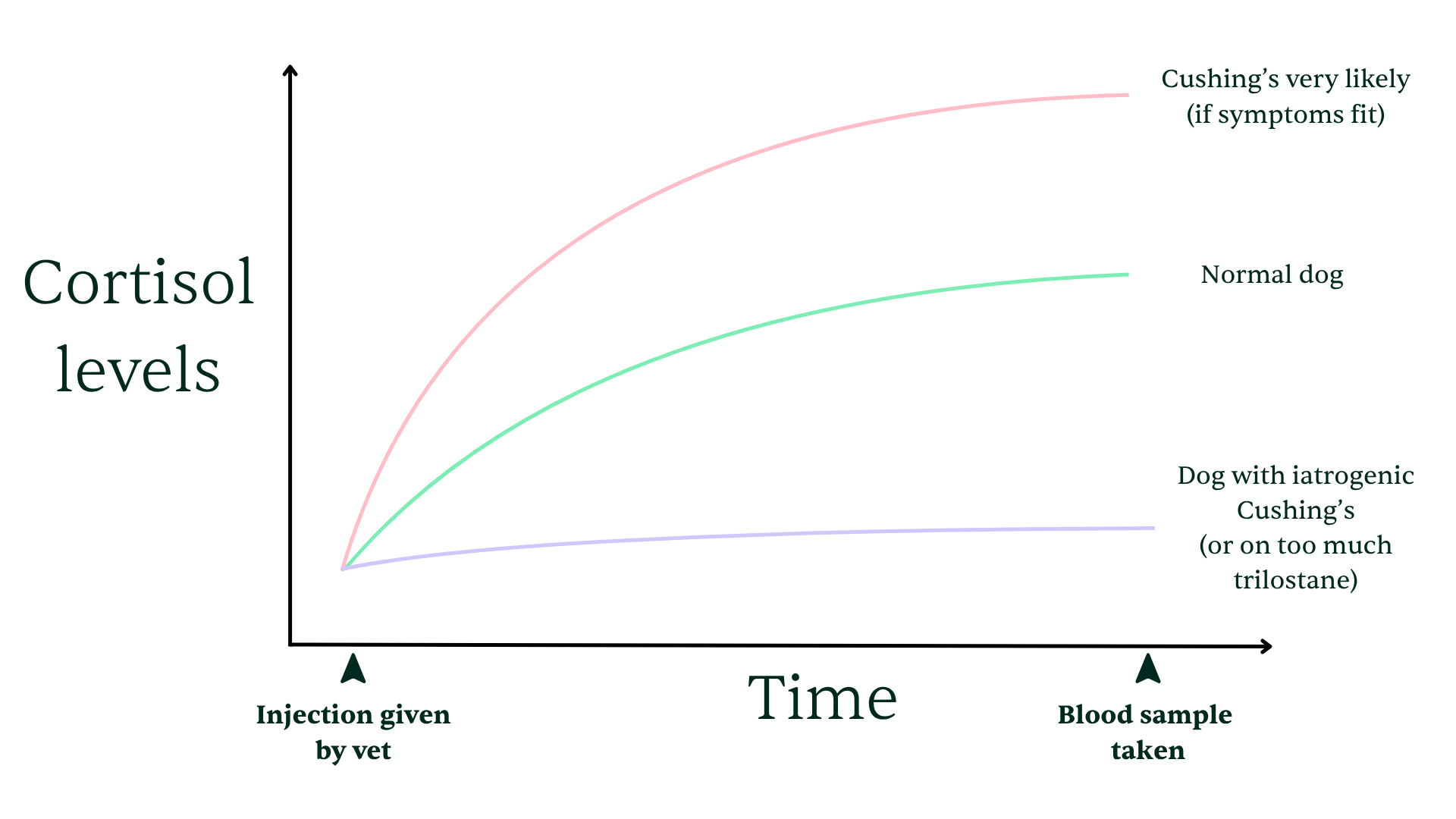
The ACTH stimulation test may be used individually for cases where the “shoe fits”, i.e. all the symptoms fit, and your vet is fairly sure your pet has the condition.
For this test, your vet will administer a dose of medication designed to stimulate the adrenal glands to release all their cortisol. They then take a blood sample an hour later to measure how much cortisol has been released.
If your dog has Cushing’s, they will have been making lots of cortisol for a while, so the adrenals are super-producers. When you then make the adrenals empty, a significant amount of cortisol enters your pet’s bloodstream.
For these pets, a positive ACTH test means your pet will likely be officially diagnosed with Cushing’s.
The low-dose dexamethasone suppression test is slightly different;
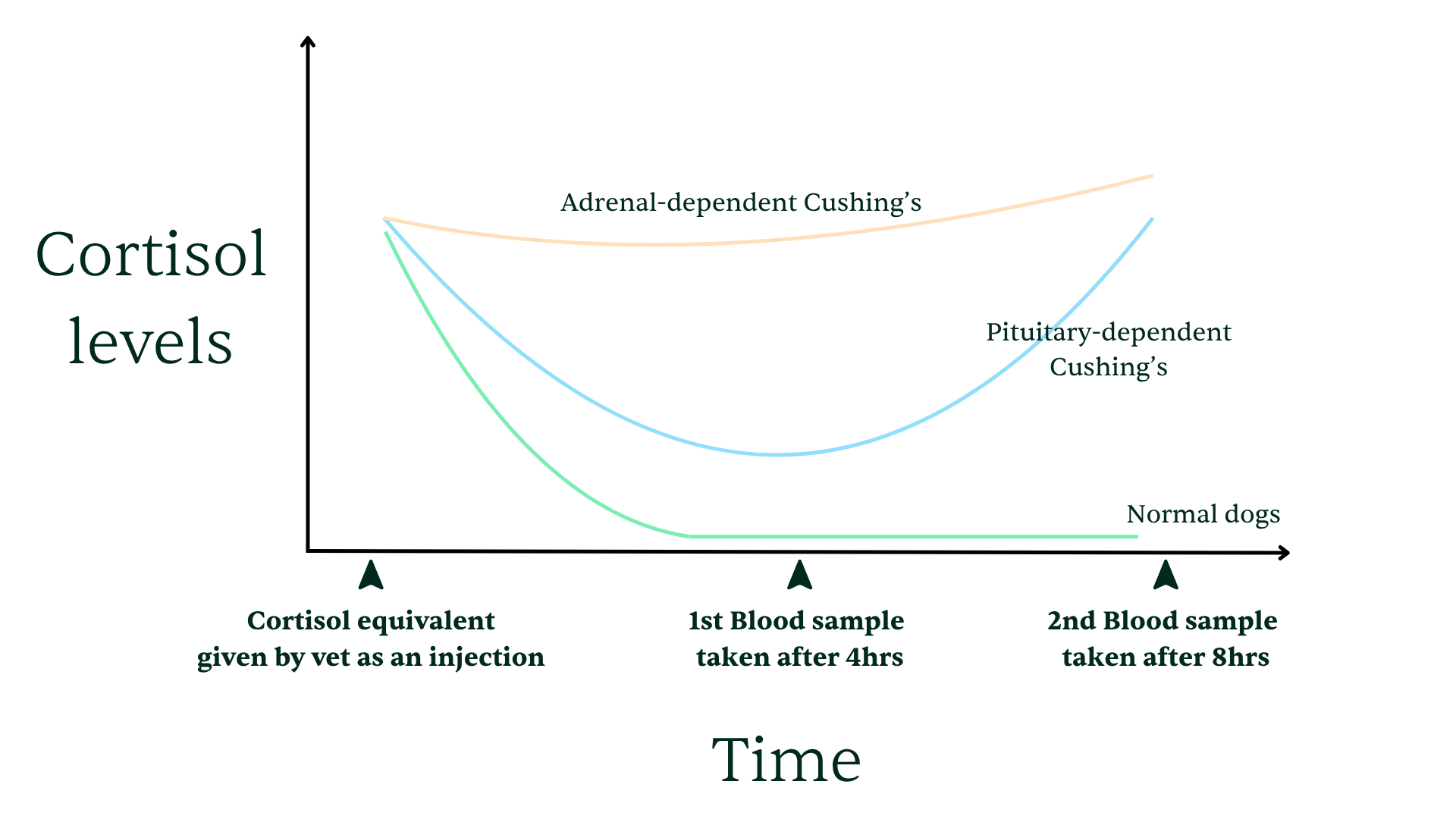
Your vet will inject your pet with a cortisol equivalent
They then take blood samples 4 and 8 hours after the injection to see how much “real” cortisol is in your pet’s blood
In healthy pets, their body recognises that this medication is in the bloodstream and is equivalent to cortisol, so it stops making its own cortisol
If your pet has Cushing’s, it cannot help itself and will continue to produce cortisol regardless of the medication.
Specifically;
- Pituitary-dependent Cushing’s will usually make less cortisol at the 4-hour mark, but by 8 hours, will be back to making lots of cortisol.
- Adrenal-dependent Cushing’s will usually continue on regardless, so both 4 and 8 hr levels will be high.
- For more unusual cases, both tests may be needed together to confirm the diagnosis.
- As mentioned above, the low-dose dexamethasone suppression test can also be invaluable for determining if the tumour is likely to be in the adrenal or pituitary glands.
- Knowing where the tumour is likely to be can help decide whether to go ahead with imaging.
Scans
These aren’t always necessary, but they can be helpful in more unusual cases or when surgery is being considered.
An ultrasound can be used to try to tell if the Cushing’s is adrenal or pituitary dependent. It can be tricky, as scanning the adrenal glands is a fairly skilled technique, so your vet may refer your pet for this procedure.
For adrenal-dependent Cushing’s, one adrenal gland (the one with the tumour) will be larger than the other.
For pituitary-dependent Cushing’s, both adrenal glands will be larger as the brain is telling the adrenals to work harder.
Treatment Options for Cushing's Disease

The goal of treatment is to reduce cortisol levels and improve your dog’s quality of life.
Treatment for Cushing’s disease depends on the type of Cushing’s your pet has, and your pet must be carefully monitored for side effects.
1. Trilostane
Trilostane is the only licensed medication for both pituitary- and adrenal-dependent Cushing's in dogs in the UK.
It works by blocking cortisol production and is typically administered once daily, although some pets may respond better to twice-daily dosing.
Key points:
- Initial dosing is carefully managed with your vet
- The aim is to try to reduce the blood cortisol level of your pet so that the Cushing’s side effects resolve, without risking an overdose.
- Regular blood and urine tests are usually needed to monitor progress.
- Medication is usually less successful for adrenal-dependent cases, and doses will often need to be steadily increased over time to try to keep the condition under control.
- The improvement from medication can usually be seen within a few weeks.
- Excessive drinking and urination often improve first (within a few days)
- Followed by improvements in appetite, coat condition, and overall energy levels
- It can often take up to 3-9 months for all of your dog’s symptoms to fully resolve
- Trilostane usually has minimal side effects, but some animals may experience vomiting, diarrhoea, or a loss of appetite, and some may also appear sleepier or less active than usual.
- Rarely, medication can cause dogs to have cortisol levels that are too low (swinging too far the other way), so if your dog becomes sleepy, trembly, goes off their food or has vomiting or diarrhoea, you should seek veterinary advice immediately.
- Sometimes, kidney disease, allergic skin disease, and arthritis that were previously “hidden” by high cortisol levels are revealed as the treatment reduces cortisol levels.
- Trilostane has also been rarely associated with bloating, drooling, wobbliness, muscle tremors, and skin disorders, and very rarely associated with weakness, permanent damage to the adrenal glands and sudden death.
- Trilostane can be bought online with a prescription, a helpful option for managing costs. You can search for your medication here if you already have your prescription.

2. Surgery
In rare cases, adrenal tumours may be removed surgically. This is complex and typically reserved for specific candidates.
3. Stopping/Reducing Steroids
For animals with iatrogenic Cushing’s (where too much steroid has been given), reducing the dose is often sufficient to stop the Cushing’s symptoms.
Completely stopping steroids “cold turkey” is never recommended. A careful reduction is needed because when the body has been receiving high doses of steroids, the adrenals “go to sleep”. Our pets need some cortisol in their bodies to stay alive, so completely stopping the medication suddenly can be very dangerous. A gradual dose reduction should keep our pets healthy while allowing the adrenal glands time to recover and start working again.

4. Careful Monitoring
Cushing’s Disease is a lifelong condition. Even with medication, your dog will need ongoing check-ups and occasional dose adjustments to stay healthy.
How monitoring works:
After medication is administered, cortisol levels drop before rising again before the next dose is due.
Your vet will usually take a blood sample just before the medication is given to give an idea of what the highest levels of cortisol are:
The aim is to keep the levels within a “safe” zone
High enough to be safe (we need some cortisol in our bodies to keep us alive, so it cannot go too low)
But not so high that your pet is getting Cushing’s symptoms and is at risk of complications due to the condition
For some animals, twice-daily dosing may be needed to get better control.
Vets will typically use the blood test results alongside questionnaires about your pet’s health to figure out what dose your pet should be on; the aim is to make your pet feel better and control the condition, rather than getting perfect blood results. Links to commonly used questionnaires are below;
CushQoL-pet: Cushing’s Quality-of-life Questionnaire
Cushing’s Clinical Score Questionnaire
In rare occurrences, if the medication dose is too high, your pet’s cortisol levels can go too low. Remember, some cortisol is essential for your pet’s body to function, so if your dog becomes sleepy, trembling, goes off their food or has vomiting or diarrhoea, you should seek veterinary advice immediately.
Can Dogs Live a Normal Life with Cushing's?
Yes. With proper diagnosis, consistent treatment, and regular monitoring, dogs with Cushing's can live happy, comfortable lives. Early detection and proactive care are key.
Cushing's Disease may sound scary, but with the right treatment and support from your veterinarian, your dog can return to feeling like its usual self.
With effective treatment, many dogs can live for several years post-diagnosis, enjoying a good quality of life.
If you're managing costs, speak with your vet about obtaining a written prescription to buy medication online safely with Petscribers.
Ask your vet for a written prescription; medication may be more affordable when purchased online.
And remember: you're not alone. Many pet owners face this diagnosis, and with clear information and a good plan, you can navigate it confidently.
While Cushing’s can’t always be prevented, avoiding unnecessary steroid use and regular check-ups for middle-aged dogs may help catch it early.
And for those who like a bit more bedtime reading, the Canine Cushing’s website is a good source of further information .
To find your dog's medication and compare prices and delivery speed, check out the Petscribers pet medication search engine.